Many spectators experience a finished performance and see seemingly effortlessly flowing movements, powerful imagery, and emotional moments.
What often remains hidden are the months or even years of creative work that go into such a production.
Because a contemporary performance rarely begins with a finished choreography.
It usually begins with a question.
This idea can originate from a wide variety of sources:
Often, at the beginning, it's completely unclear what the finished production will look like.
There is merely an impulse.
In Contemporary Circus, research is an important part of the process.
Artists ask questions:
Many ideas fade away.
Others evolve.
Unlike many traditional productions, choreography isn't immediate.
First, there is exploration.
Movement is experimented with.
Changed.
Discarded.
Rediscovered.
This openness is one of the most important characteristics of contemporary art.
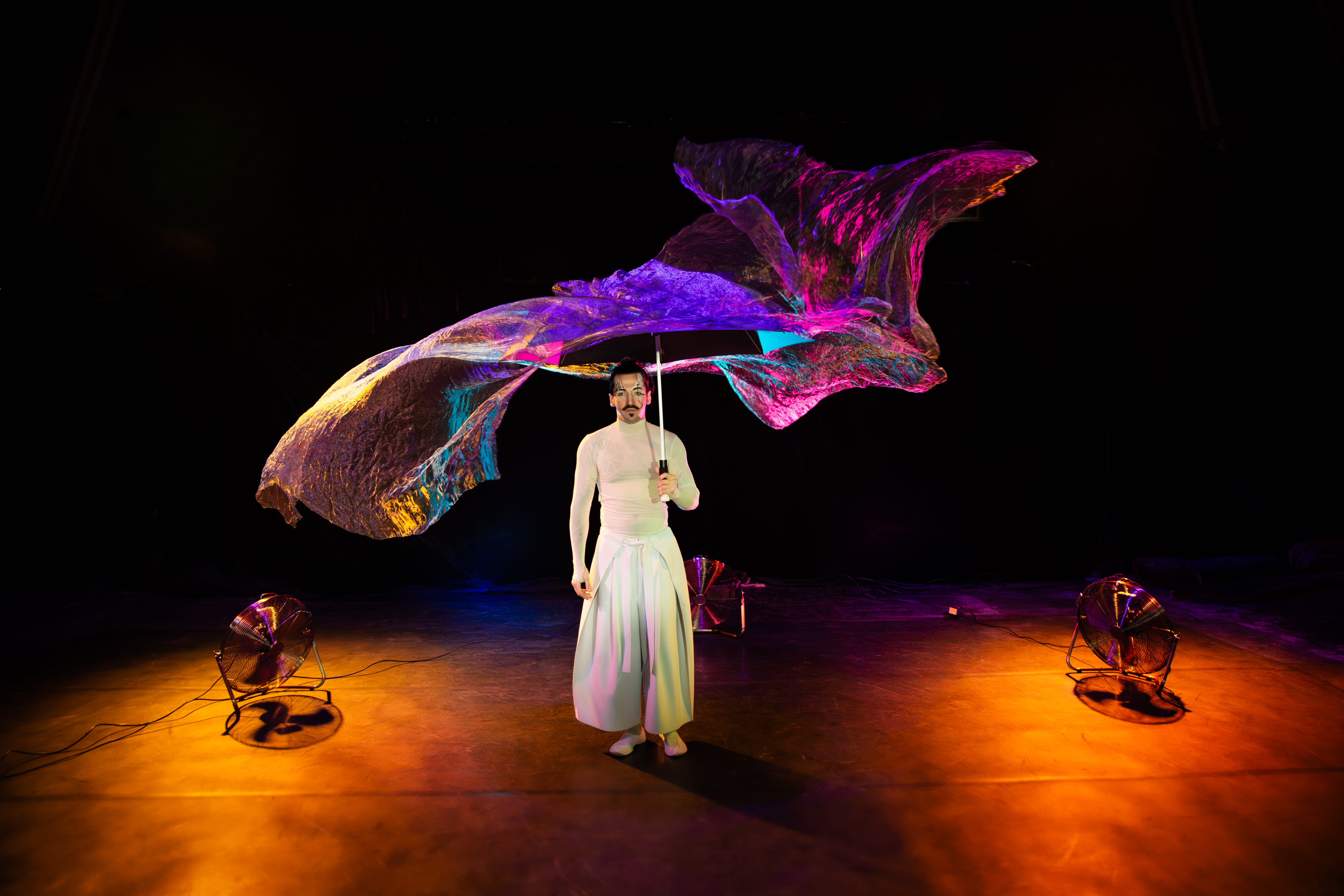
It becomes particularly interesting when objects become part of the creative process.
Fabric behaves differently than a rod.
A wheel creates different movements than a rope.
The properties of the material influence the resulting performance.
Eventually, the question arises:
Why does this scene exist?
What is its function?
What emotion does it convey?
This is where the dramaturgical work begins.
Contemporary productions often don't tell linear stories.
Nevertheless, they have a dramaturgy.
They work with:
This creates an emotional arc.
The truth is:
Actually, never.
Many artists continue to develop their work even after the premiere.
New experiences change the performance.
The piece remains alive.
A contemporary performance does not arise from a fixed plan.
It grows out of experiments, questions, and discoveries.
It is precisely this openness that makes contemporary circus and modern performance art so exciting.
Depending on the project, between a few weeks and several years.
Often not. Many productions begin with research and improvisation.
Because new movements and ideas often only emerge through experimentation.


.webp)

